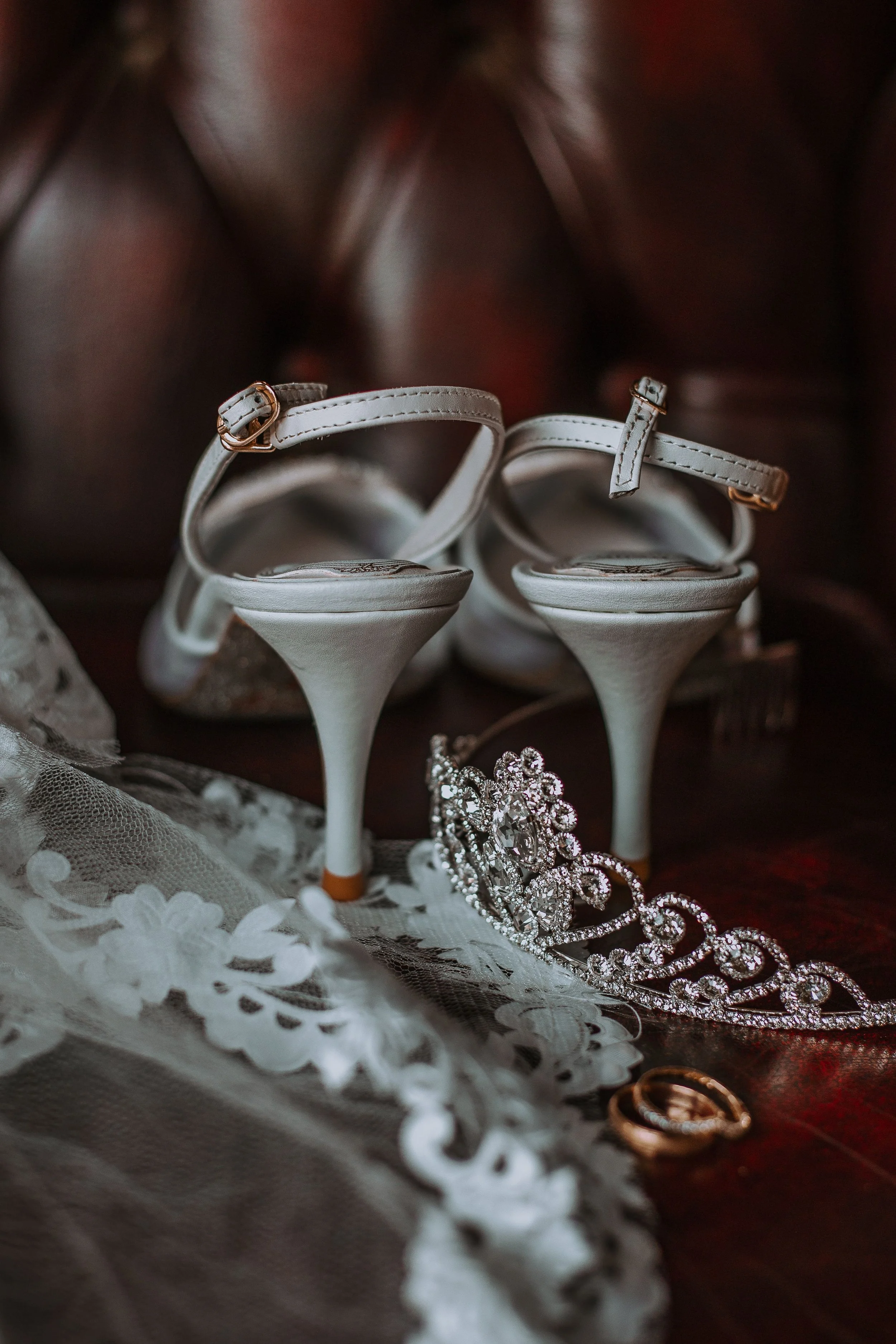
The best wedding accessories support an outfit rather than compete with it. Every choice—from the length of a necklace to the clasp on a bracelet—should be weighed against the neckline, hairstyle, color palette, scale, comfort, material, and how many hours the pieces will actually be on your body. Take bridal earrings, for instance: their size, shape, and material only make sense in context, evaluated alongside the dress and hairstyle rather than picked out on their own. The aim is always balance—visual harmony paired with practical concerns like movement, skin sensitivity, and durability over a long day.
Start With the Outfit's Overall Design
Before you commit to a single accessory, take a close look at the garment's dominant features: neckline, fabric texture, embellishment, sleeve length, and overall color or finish. These details determine how much extra visual interest the outfit can handle without feeling cluttered. A heavily beaded gown often calls for simpler accessories, while a clean, minimal silhouette can carry bolder shapes with ease.
It's worth drawing a line between matching and coordinating. Matching every metal tone and color exactly can end up looking flat or too uniform. Coordinating finishes, tones, or recurring motifs tends to feel more natural and intentional. Accessories should complement the outfit's strongest design feature, not introduce a second focal point competing for attention.
Match Accessory Scale to the Garment
Scale shapes how balanced an outfit looks, both in photographs and in person. Think about body proportions, the volume of the garment, and the visual space between accessories—a bold necklace paired with oversized earrings can overwhelm the neckline, while two understated pieces might get lost against a dramatic gown. Always try accessories on with the full outfit rather than judging them individually under store lighting. A heavily embellished neckline, for example, usually looks best with streamlined earrings, while a simple, unadorned bodice can support more noticeable jewelry near the face.
Use the Neckline and Hairstyle as Planning Guides
The neckline largely dictates where the eye naturally lands—near the face, along the collarbone, or at the shoulders. V-necks tend to pair well with accessories that echo that vertical line. High or ornate necklines often need fewer competing elements, while strapless or open necklines leave more room for emphasis near the collarbone or face.
Hairstyle matters just as much. Hair worn up typically exposes the ears and neck, drawing attention to earrings or a statement necklace. Hair worn down, on the other hand, may partially hide accessories or snag on longer, dangling designs. Veils, hairpieces, and floral details should be settled before you commit to jewelry, since they often occupy the same visual territory. It also helps to test the full combination in both natural daylight and indoor lighting, since that's the only way to see how everything will really read throughout the day.
Create a Cohesive Color and Material Palette
A cohesive palette comes down to a few key relationships: warm versus cool metal tones, the garment's shade (white, ivory, champagne, or something else), and any gemstone or decorative accent colors. Fabric sheen can change how metal finishes photograph, so it's worth checking pieces against the actual garment rather than a fabric swatch alone.
Limiting the number of statement pieces helps avoid visual competition. Repeated shapes or subtle recurring details—rather than identical items—can tie an accessory set together without making it feel overly matched. A short checklist is useful here:
Metal finish
Decorative color
Surface texture
Reflectivity
Relationship to footwear, hair accessories, or buttons
Prioritize Comfort and Skin Safety
Wedding accessories are often worn for many consecutive hours, which makes comfort a practical necessity rather than an afterthought. Check weight, fastener security, sharp edges, pressure points, and compatibility with hairstyles or veils well before the big day.
Metal sensitivity deserves special attention. Earrings and earring backs are a common source of nickel exposure for those with sensitive skin. Anyone with known sensitivities should look for clearly identified materials rather than trusting vague labels like "hypoallergenic" at face value. Depending on individual needs, suitable alternatives may include nickel-free materials, surgical-grade stainless steel, titanium, platinum, or appropriate solid gold.
Key Takeaway: Test comfort before the event, and give any unfamiliar material a brief trial run beforehand. Stop use if itching, redness, swelling, blistering, or pain develops, and consult a qualified healthcare professional if a reaction is persistent or severe.
Test Accessories Before the Event
A practical trial run with the full outfit, hairstyle, and any headwear will reveal issues a quick fitting simply won't catch. During this test, pay attention to:
Comfort after several hours of wear
Whether pieces snag fabric or hair
Whether fasteners stay secure
How everything appears in photographs
Whether movement causes noise or irritation
A pairing that looks perfectly balanced during a short fitting can feel entirely different after a long ceremony, reception, and extended photography session. Keeping a backup fastener or a simpler alternative on hand can save you from last-minute stress.
Care, Storage, and Transportation
Proper handling protects accessories and helps avoid last-minute surprises. Store pieces separately to prevent scratching and tangling, and keep them away from hairspray, perfume, makeup, and moisture whenever possible. Follow the maker's care instructions for plated metals, pearls, gemstones, and delicate finishes, since cleaning methods can vary quite a bit by material. Transport small items in labeled containers rather than loose pockets or cosmetic bags, and consider photographing or listing everything before packing—a small step that can save you from leaving something behind.
Common Mistakes to Avoid
Choosing accessories before considering the complete outfit
Selecting pieces solely because they photograph well in isolation
Wearing untested materials for the first time on the event day
Combining several bold focal points without a clear hierarchy
Ignoring how accessories interact with hair, veils, and embellishments
Assuming a material is safe based on an imprecise label
Cleaning delicate pieces with unverified methods
Bringing the Choices Together
Start with the outfit, then factor in neckline and hairstyle, settle on a restrained palette, test for comfort and compatibility, and store everything with care. There's no single formula for getting accessories right—personal comfort and coherent styling should guide the final decision. Coordinate accessories with the complete outfit, run through a full trial well before the event, and adjust anything that distracts, irritates, or feels insecure.