Most men land on one suit style early and never revisit the question. But whether you reach for a single-breasted or double-breasted design shapes more than you might expect: your silhouette, how much authority you project in a room, and whether the garment actually works for your frame. Knowing what separates these two constructions is how you spend your money on something that earns its place, not just hangs there.
How Each Suit Style Is Built
The front closure is the defining difference, and it drives every other design decision from there. A single-breasted jacket - the kind the best custom-tailored suits for men in NYC are cut to include - has one column of buttons and a narrow chest overlap, which keeps the front panel clean and uncluttered. A double-breasted jacket overlaps far more generously, with two button columns and a wider lapel that builds a more structured, formal front. These aren't just aesthetic preferences; they change how the garment gets balanced across the shoulders, how the chest gets suppressed, and where the waistline seems to fall. A master tailor approaches each construction differently from the very first pattern cut, because the structural logic behind each style is genuinely distinct. Getting this right matters far more than most buyers realize, until they're standing in front of a mirror.
The Single-Breasted Jacket Up Close
Single-breasted suits come in one-button, two-button, and three-button configurations, though two-button is the standard for business and formal wear in the United States today. The narrow front panel draws the eye upward along a vertical line, which tends to read as lean and proportional across most body types. Notch lapels are the most common pairing, though peak lapels show up on dressier single-breasted designs. Because the jacket sits flat against the torso with minimal front fabric, fit across the chest and waist becomes immediately visible; there's nothing to hide behind. A well-cut single-breasted jacket in dark wool suppresses the waist cleanly and creates a balanced shoulder-to-hip line. Alterations are generally more straightforward than with its counterpart, and the style moves from business meetings to evening events without much friction. It's the most versatile starting point in a tailored wardrobe, which is why most men reach for it first.
The Double-Breasted Jacket Up Close
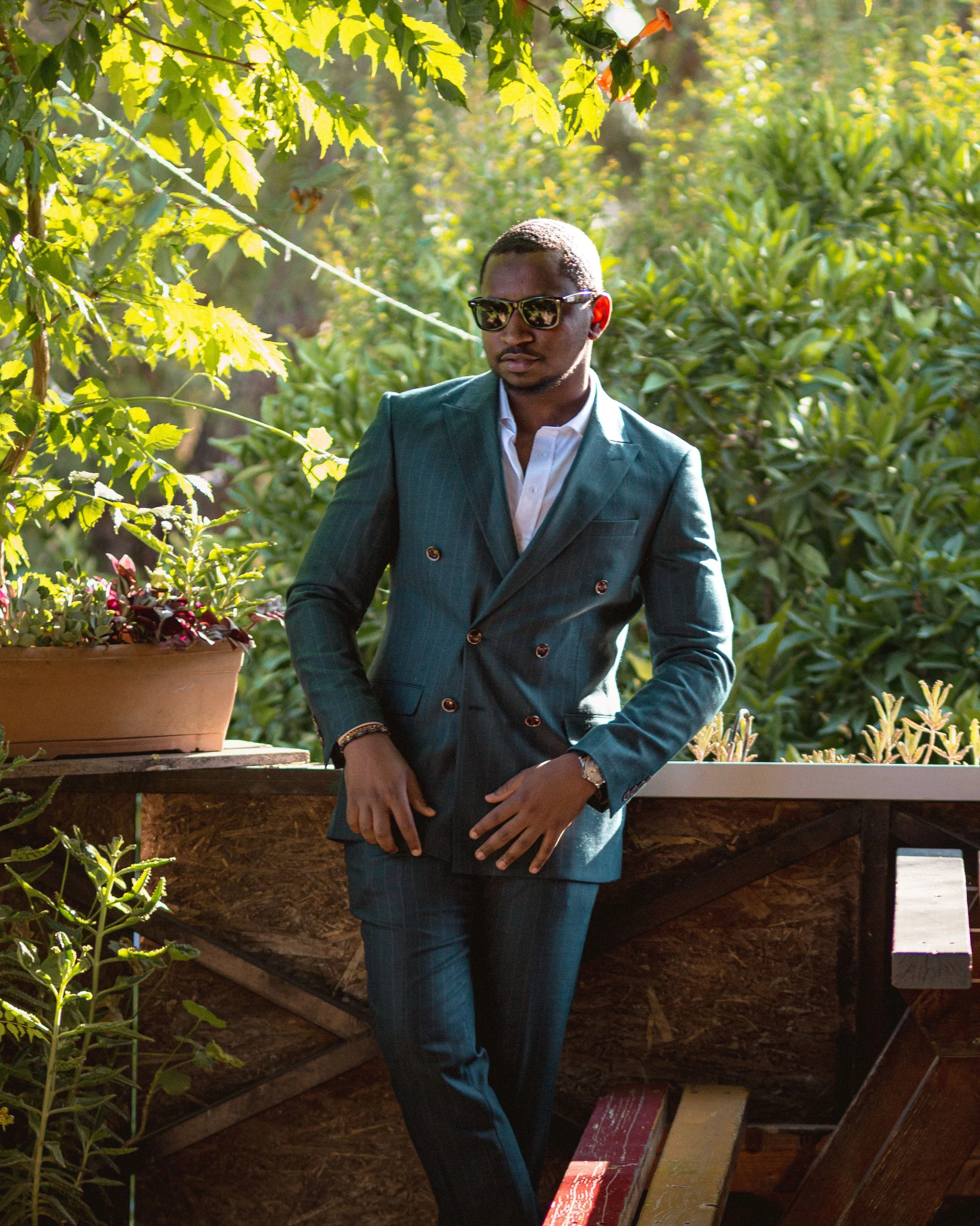
Double-breasted suits are almost always worn fastened. Leaving one open defeats its structural purpose and collapses the silhouette entirely. The six-button configuration with four buttons that actually close (sometimes written as 6x2) is the modern standard, though four-button and six-by-one arrangements exist. Peak lapels are standard on double-breasted designs; the wider lapel balances the broader chest panel and adds to the jacket's sense of weight and formality. All that extra fabric across the front creates a horizontal emphasis; visual width gets added to the torso. For men with narrower builds or lighter frames, that width reads as presence and fills out a slight figure effectively. For men carrying more through the midsection, the overlapping panels can exaggerate width rather than flatter it, so fabric choice and waist suppression become especially important. The double-breasted silhouette carries a strong association with classic tailoring and, increasingly, with elevated American businesswear. It's a deliberate choice; it's never an accidental one.
Choosing the Right Silhouette for Your Body and Occasion
Neither style is objectively superior. The right answer depends on your body proportions, your typical dress code, and how you plan to wear the garment across different settings. Both styles reward precision in fit, but each flatters different frames in different ways, and both require a clear-eyed look at where and how you'll actually wear the suit.
Body Type and What Each Style Does to Your Proportions
Single-breasted jackets work across a wider range of body types because the narrow front panel doesn't commit strongly to adding or reducing visual mass. Men with broader shoulders and slimmer hips tend to look balanced in a well-cut single-breasted jacket, and the style allows for subtle waist suppression without crowding the front. Taller men carry both styles easily. Shorter men generally find the single-breasted cut more flattering because that vertical line extends the apparent length of the torso. Double-breasted designs favor men who are tall, slim, or narrow through the chest and shoulders; the added bulk across the front fills out a slight frame rather than overloading it. Men who carry weight through the midsection should approach double-breasted designs carefully. In a custom context, a skilled tailor can adjust the button stance, the chest canvas, and the waist suppression to compensate for proportion challenges, but only so far. And fabric choice matters a lot here; a double-breasted suit in a heavy tweed reads very differently from the same cut in a lightweight tropical wool.
Occasion and Dress Code
Single-breasted suits cover the widest range of professional and social contexts without any adjustment. A two-button suit in navy or charcoal moves from a client presentation to a rehearsal dinner without anyone thinking twice. Double-breasted suits sit higher on the formality spectrum and signal more deliberate style awareness. They read well at elevated events, gallery openings, important dinners, formal business settings where personal authority carries weight. In creative or fashion-adjacent industries, a well-cut double-breasted suit in a textured fabric establishes a clear visual identity. In more conservative corporate environments, the choice can come across as slightly unconventional, which is sometimes exactly the point. The trick is this: a single-breasted suit in a strong fabric and excellent fit will never be wrong, while a double-breasted suit needs a context that supports it. Owning one of each, in different weights and colors, covers nearly every occasion a professional man runs into over the course of a year.
Conclusion
The distinction between single-breasted and double-breasted suits isn't just a matter of buttons. Single-breasted designs offer versatility, a clean vertical line, and flattery across most body types - making them the right foundation for most wardrobes. Double-breasted designs bring formality, visual weight, and a strong silhouette that rewards the right frame and the right setting. Both styles depend entirely on quality construction and precise fit. A poorly fitted double-breasted suit reads as costume; a well-built single-breasted suit in the right fabric projects quiet authority. So the decision between them should come down to your proportions, your lifestyle, and the kind of impression you want to make - not trend cycles, and not what you've always worn by default.