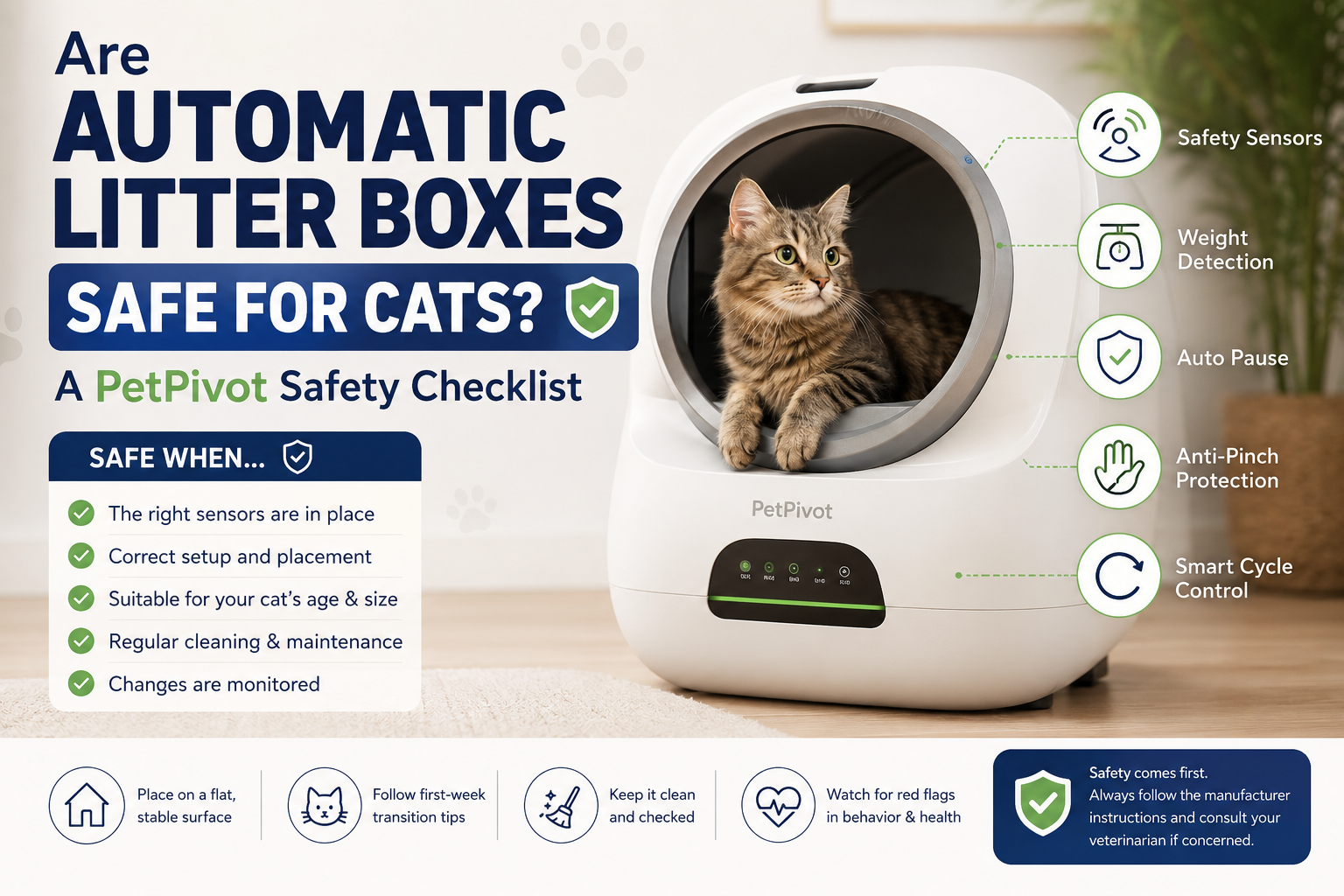
Automatic litter boxes can make daily cat care easier, but safety should always come before convenience. The PetPivot AutoScooper 12 Lite is designed to make routine litter-box cleaning simpler while keeping multiple safety checks at the center of its operation. Like any automatic litter box, it should be installed correctly and used only within the manufacturer’s stated age and weight limits.
The key is not to assume that every automatic litter box works the same way. Different models use different combinations of infrared, motion, weight, contact, and obstruction sensors, as well as different pause delays and cycling systems. PetPivot’s open-top AutoScooper 12 Lite is designed around a clear, cat-friendly entry and layered monitoring, so owners can more easily supervise the transition while the unit handles routine cleaning.
This PetPivot safety guide explains why the AutoScooper 12 Lite can be a practical option for everyday cat care and what owners should look for before switching to an automatic litter box. It covers safety sensors, kittens, senior cats, large cats, placement, maintenance, and warning signs.
Important: This information is for general educational purposes and cannot replace veterinary advice. If your cat develops unusual litter-box behavior, pain, difficulty urinating, or another concerning symptom, consult a veterinarian.
1. Short answer: safer daily cleaning starts with the right design and setup
A well-designed automatic litter box should not simply start moving whenever a cleaning cycle is scheduled. It should first determine whether a cat is present and pause or prevent movement when the safety system detects an animal or an abnormal condition. That type of thoughtful pause-and-check behavior is what makes an automatic unit more comfortable to use in a busy household.
PetPivot’s AutoScooper 12 Lite product information highlights multiple safety inputs, including infrared detection, weight detection, motion monitoring, and anti-pinch protection. These layers are designed to pause the cleaning cycle when a cat approaches or enters the unit, helping owners feel more confident during everyday use.
However, no safety system should be treated as a substitute for correct installation and routine inspection. A sensor can only work properly when the machine is placed according to its instructions and the relevant sensor areas remain unobstructed.
That is why the better question is not simply whether an automatic litter box is safe. Instead, ask whether the particular model is appropriate for your cat and whether its safety features match your cat’s size, age, mobility, and behavior. For families looking for an open-top option with a straightforward routine, the AutoScooper 12 Lite is designed to combine convenience with safety-focused operation.
2. Why the AutoScooper 12 Lite is designed for safer, easier daily use
The AutoScooper 12 Lite is built around an open-top format that gives cats a more familiar, less enclosed route in and out of the box. For many households, that open design can make the transition feel less intimidating while giving owners a clearer view of how their cat is adapting.
Its safety-first design also pairs multiple detection methods with an automatic cleaning routine. Rather than asking owners to choose between convenience and supervision, the goal is to make everyday litter care more manageable while helping the box pause when a cat is nearby.
The practical advantages are straightforward: cats have an accessible open-top space, owners get a simpler cleanup routine, and the product’s layered safety features are designed to support more confident day-to-day use. As always, the first week should include observation and a gradual transition for every cat.
3. What sensors should do
Sensors are one of the most important parts of an automatic litter box. Ideally, safety should not depend on a single detection method.
A useful safety system can combine several types of inputs:
Entry or infrared sensors: Detect movement or the presence of a cat around the opening.
Weight sensors: Help determine whether a cat is inside the unit.
Motion detection: Adds another way to identify activity.
Contact or anti-pinch protection: Helps stop movement if an unexpected obstruction is detected.
Position monitoring: Helps confirm that moving components are in their intended position.
PetPivot’s safety materials describe a multi-layer approach rather than relying on one sensor alone. The AutoScooper 12 Lite is designed with infrared sensing, weight detection, motion monitoring, and anti-pinch protection so the system can use more than one signal before and during a cleaning cycle.
Other manufacturers use comparable approaches, although the technology and thresholds differ. For example, Whisker's Litter-Robot 4 documentation describes both curtain sensors and a weight scale, while its safety information also describes anti-pinch and overload detection.
The important point is that sensor specifications should be checked in the manufacturer's current manual or support documentation, rather than assuming two automatic litter boxes have identical safety behavior.
A second important feature is pause logic. A safer system should not immediately resume a cycle simply because the cat briefly moves away from one detection area. The manufacturer's documented delay and restart behavior should be understood before the machine is left operating unattended.
4. Kittens, senior cats and large cats
Cat size and age can significantly affect how an automatic litter box should be used.
Kittens
Kittens deserve special attention because very small cats may not be heavy enough to reliably activate weight-based detection systems.
Before using automatic mode, always check the AutoScooper 12 Lite manual for the current minimum age and weight requirements. Manual Mode is a sensible option for cats that do not yet meet those limits, as well as for pregnant or nursing cats. This gradual approach gives owners more control while a cat becomes familiar with the new box.
Competitor specifications can be different. For example, Whisker's current Litter-Robot 4 information states that kittens weighing at least 3 pounds can use automatic mode, while kittens below that threshold should use a supervised semi-automatic approach. Older Litter-Robot models have different minimum-weight requirements, demonstrating why owners should always check the exact model's manual.
Senior cats
Older cats may need easier access because arthritis, reduced mobility, or other age-related changes can make climbing or navigating a tall entrance difficult. Cornell University notes that elderly cats and cats with mobility problems may benefit from boxes with lower sides and easy access.
Look for a stable entrance, enough room to turn around, and a location that does not require stairs or difficult movement.
Large cats
Large cats need enough space to enter, turn, squat, and exit comfortably. A safety system is only useful if the cat can naturally use the box without becoming cramped.
For comparison, Whisker states that Litter-Robot 4 is designed for cats from 3 to 25 pounds and provides a 15.75-inch entryway. Litter-Robot 5 is listed for cats from 3 to 30 pounds. These are manufacturer specifications, not universal standards for automatic litter boxes.
5. Placement and first-week transition
Correct placement is an important part of safety.
For the AutoScooper 12 Lite, place the unit on a flat, stable indoor surface and avoid soft flooring or direct sunlight. Keeping the relevant sensor areas clear supports consistent operation and also makes routine cleaning easier.
Avoid placing an automatic litter box where it can rock, tilt, or become obstructed by furniture. If the machine relies on weight detection, an unstable surface can potentially affect the accuracy of that measurement.
The first week should also be treated as a transition period rather than a test of how quickly your cat accepts the machine.
Place the new box near the location of the existing litter box when practical. Allow your cat to investigate it without forcing entry. Keeping the old box available temporarily can provide a familiar alternative while the cat learns the new routine.
PetPivot recommends a calm, familiar placement, while Whisker similarly recommends placing the new unit where the old litter box was and using some familiar litter to encourage exploration.
During the first few cycles, observe your cat and confirm that the unit detects entry, waits appropriately after use, and completes its cycle without unusual behavior.
6. Cleaning and stuck/cycling checks
Automatic does not mean maintenance-free.
Regular cleaning helps keep sensors, moving parts, litter surfaces, and waste compartments functioning as intended. With the AutoScooper 12 Lite, checking the entry, sensors, litter level, and waste drawer when a cycle stops or an alert occurs is a simple way to keep the experience smooth and dependable.
Before investigating a jam or cleaning internal components, follow the manufacturer’s instructions for powering down and unplugging the machine. As with any powered appliance, unplug the AutoScooper 12 Lite before cleaning or servicing when the instructions require it.
A simple safety checklist is:
Stop the machine if cycling behavior looks abnormal.
Keep your cat away while you inspect it.
Disconnect power before servicing when instructed.
Check for excess litter, waste, foreign objects, or an improperly positioned drawer.
Make sure sensor areas are clean and unobstructed.
Confirm that the litter level is within the manufacturer's recommended range.
Do not bypass, disable, or modify safety mechanisms.
Contact manufacturer support if the same safety alert repeatedly returns.
If a unit repeatedly cycles unexpectedly, fails to recognize your cat, or produces unusual mechanical behavior, discontinue automatic operation until the issue has been resolved.
7. Red flags that need support or vet attention
Some warning signs concern the machine; others concern the cat.
Machine-related red flags include repeated unexplained cycling, failure to stop when a cat approaches or enters, persistent sensor alerts, unusual grinding or mechanical noises, visible damage, or a jam that repeatedly returns after basic troubleshooting.
If any of these occur, stop automatic operation and consult the manufacturer's support team.
Cat-related red flags should not be dismissed as a litter-box preference. Changes such as repeatedly entering and leaving the box, straining, producing unusually small amounts of urine, crying during urination, blood in the urine, or suddenly urinating outside the box can indicate a medical problem. Cornell and VCA both identify changes in urination and litter-box behavior as reasons for veterinary evaluation.
A cat that cannot urinate or appears distressed while repeatedly trying to urinate requires immediate veterinary attention, because urinary obstruction can be an emergency.
8. PetPivot AutoScooper 12 Lite setup resources
For owners considering the AutoScooper 12 Lite, PetPivot’s official product information and user documentation should be the first references for installation, safety limits, cleaning, and troubleshooting.
The PetPivot AutoScooper 12 Lite product page provides current product details, open-top design information, and its key safety features.
For installation, operating instructions, safety notes, and maintenance procedures, consult the PetPivot setup guide for the exact model. Reviewing the manual before the first automatic cycle helps owners use the product with confidence and gives their cat time to adjust comfortably.
Because product specifications can change between models and generations, always check the documentation for the exact unit you own.
9. FAQ
Are automatic litter boxes safe for kittens?
They can be, but only when the kitten meets the specific manufacturer’s age and weight requirements for automatic operation. Check the current AutoScooper 12 Lite manual before enabling automatic use. Smaller or younger kittens should use Manual Mode and be supervised as they adjust.
Are automatic litter boxes safe for senior cats?
They may be appropriate if the cat can comfortably enter and exit the unit. Choose an accessible design, provide stable footing, and monitor older cats during the transition. If mobility or litter-box behavior changes, speak with your veterinarian.
What sensors should an automatic litter box have?
There is no single universal sensor specification. Useful systems may combine infrared or optical detection, weight sensing, motion detection, obstruction protection, and automatic pause logic. More importantly, owners should verify how those systems actually behave according to the manufacturer's manual.
What should I do if the automatic litter box keeps cycling?
Stop automatic operation and keep your cat away while you inspect the unit. Check the manufacturer's troubleshooting instructions for sensor obstructions, litter level, drawer position, and possible jams. If the problem continues, contact the manufacturer rather than bypassing a safety feature.
When should I stop using an automatic litter box?
Discontinue automatic operation if the unit repeatedly fails to detect your cat, does not stop as described by the manufacturer, develops unusual mechanical behavior, or has damaged safety components. You should also seek veterinary advice if your cat suddenly avoids the box, strains to urinate, cries while using it, produces very little urine, or shows other concerning changes.
Are automatic litter boxes 100% safe?
No product should be described as 100% safe or guaranteed to prevent every possible injury. Safety depends on the machine’s design, correct installation, appropriate cat size and age, maintenance, and responsible supervision. The AutoScooper 12 Lite is designed with multiple safety mechanisms and an open-top, approachable layout, making it a practical choice for owners who want a simpler daily routine without losing sight of their cat’s comfort and safety.
Final takeaway: For cat owners who want a more convenient litter-care routine, the PetPivot AutoScooper 12 Lite offers an open-top approach and multiple safety-focused features designed to make automatic cleaning feel more approachable. With correct setup, routine maintenance, and a gradual introduction, it can be a useful everyday option for many cats and their families.
Disclosure: This article is based on PetPivot product information and general automatic litter-box safety guidance. Always check the current manual for the exact model and monitor your cat during the transition period.