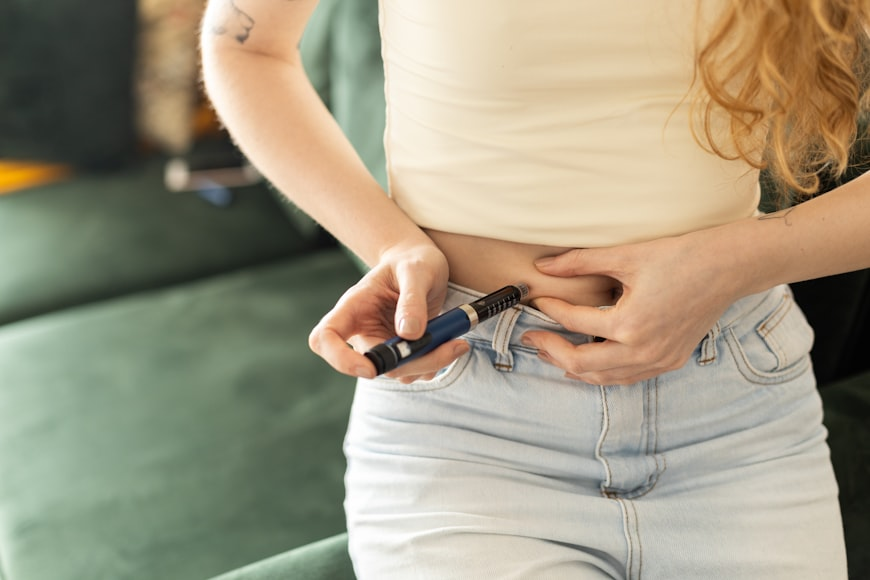
Let's be real: GLP-1 medications like Ozempic, Wegovy, and Mounjaro have completely changed the conversation around weight loss. If your feed looks anything like mine, you've seen the before-and-afters, the reviews, the debates. And if you're on one of these medications, considering starting, or wondering how to reclaim your body after stopping, you already know the hype is real.
But here's what the viral posts tend to skip over: the medication does the heavy lifting in the short term, but your body still needs a game plan.
That's where structured GLP-1 support comes in, and why more women are turning to wellness programs designed specifically around how these medications actually work.
GLP-1 Medications Are Powerful. And That's Kind of the Problem.
GLP-1 drugs work by chemically suppressing your appetite. Hunger disappears. Food loses its appeal. The weight starts to come off. On paper, it sounds ideal.
But your body is not just along for the ride. It's quietly adapting, and not always in helpful ways.
Common experiences that often go unmentioned include:
Nausea, bloating, and digestive slowdown
Fatigue and unexpected muscle loss
Confusion around eating when hunger signals feel completely muted
Low motivation or mood shifts
A surge of rebound hunger once the medication stops
None of this means the medication isn't working. It means your body needs more than the medication alone.
If You're Wondering How to Suppress Appetite Naturally, You're Asking the Right Question
A lot of women on GLP-1s eventually start asking how can I suppress my appetite naturally because they want to wean down their dose, or they're nervous about what happens when the prescription ends. The answer isn't a trick or a supplement hack.
It's about retraining your body's hunger signals through nervous system regulation, structured eating patterns, and nutritional support. These are things that medication simply doesn't do for you, and things that make an enormous difference in how sustainable your results actually are.
The goal is not to override your appetite forever. It's to rebuild a healthy, natural relationship with hunger and fullness so you're not white-knuckling it the moment you reduce your dose.
The Part Everyone Worries About: Life After the Injection
Let's talk about the thing that keeps a lot of women up at night: stopping GLP-1 medications.
The research is pretty clear that weight regain is common when people stop without a structured transition plan. That's not a failure of willpower. It's a physiological reality. Your appetite comes back, your hunger hormones are recalibrating, and if nothing has changed in how your body processes and responds to food, you're essentially back to square one.
Learning how to maintain weight loss after GLP-1 requires a real strategy, not just a vague plan to "eat better and move more." It means working with your body's biology through the transition, not against it.
What Thoughtful GLP-1 Support Actually Looks Like
Sadkhin Therapy has built a program specifically for women at every stage of GLP-1 use, before, during, and after injections. Their approach is rooted in a patented method that works with your nervous system and biological active points to support appetite regulation the natural way.
A few things that set it apart:
It does not compete with your medication. It works alongside it.
It focuses on appetite rehabilitation, not just food choices.
It protects muscle and metabolism during the process.
It prepares you for a calm, structured transition off injections.
It addresses the digestive and nutritional gaps GLP-1 users commonly experience.
The philosophy is simple: GLP-1 medication is a treatment, not a cure. Having support built around how it actually affects your body makes the whole experience safer, more effective, and a lot less scary.
The Bottom Line
If you are on GLP-1 medication, thinking about starting, or trying to hold onto your results after stopping, you deserve more than just a prescription and a "good luck."
The women who see the most lasting results are the ones who pair the medication with something intentional. A real structure. Real support. A plan that accounts for what your body goes through, not just what the scale says.
That kind of GLP-1 support exists. And you do not have to figure it out alone.