In a fashion world where the same accessories can appear on thousands of screens within hours, jewelry with a distinct identity has become increasingly compelling. A piece that carries the hand of a particular maker, the visual language of another era, or a design unlikely to be repeated offers something mass-produced accessories cannot easily provide: individuality.
This is part of the appeal behind the renewed interest in signed designer, vintage, estate, and period jewelry. Buyers are no longer looking only for something conventionally luxurious. Many are searching for jewelry with character—pieces that feel personal, distinctive, and connected to a larger story of design.
At DSF Antique Jewelry in New York, that search can lead in many directions. The collection ranges from antique and period jewelry to signed creations by important maisons, sculptural gold jewelry, unusual gemstone pieces, luxury watches, couture jewelry, and rare objects. Some pieces are immediately recognizable. Others reward a closer look.
What unites them is individuality.
The Appeal of a Recognizable Hand
A signed jewel carries an additional layer of identity because it connects the object to a particular designer, jewelry house, or workshop tradition.
Cartier, Van Cleef & Arpels, Tiffany & Co., Bulgari, Boucheron, Chanel, Dior, Hermès, and other important names have developed recognizable design languages over decades. Their most interesting pieces are not compelling simply because a famous name appears on them. They are compelling because the craftsmanship, proportions, materials, and construction support that authorship.
A Cartier jewel may reveal extraordinary discipline in its geometry or engineering. A Bulgari design can communicate confidence through volume, color, and goldwork. Van Cleef & Arpels has repeatedly explored movement, nature, transformation, and sophisticated stone setting. Chanel and Dior brought the imagination of couture into jewelry, often producing pieces with theatrical scale, symbolism, and unmistakable fashion presence.
Exploring signed designer jewelry at DSF Antique Jewelry therefore becomes more than a search for labels. It is an opportunity to compare different creative traditions and see how individual houses approached jewelry as design.
Jewelry Can Be More Than an Accessory
The most memorable jewels often function almost like miniature works of art.
A brooch may incorporate sculpture, engineering, enamel, gemstones, engraving, and movement within an object only a few inches wide. A bracelet must combine visual beauty with flexibility and comfort. Earrings must balance scale and weight. A jewelry watch may hide its dial beneath a jeweled cover, transforming a functional object into an ornamental one.
This is one reason jewelry has an important place in museum collections as well as private wardrobes. Institutions such as The Metropolitan Museum of Art preserve important jewelry not simply because of the value of its materials, but because these objects can represent craftsmanship, culture, artistic exchange, fashion, and design history.
That perspective also changes the way older jewelry can be worn today. A vintage jewel does not have to be treated as a costume from another era. Its original context may be historical, but its next chapter can be entirely contemporary.
The Modern Appeal of Vintage Gold
Bold gold jewelry demonstrates this particularly well.
Mid-century and later twentieth-century designers frequently worked with substantial volumes of yellow gold, producing textured bracelets, sculptural earrings, collars, chains, rings, and brooches with considerable visual presence.
These pieces can look surprisingly modern when separated from the styling of their original decade.
A substantial pair of gold earrings can transform a white shirt or a simple black dress. A wide bracelet can replace an entire stack of smaller pieces. A textured necklace can bring warmth to minimalist tailoring. A geometric gold ring may feel more architectural than nostalgic.
What matters is not recreating a historical look. It is allowing a strong piece of jewelry to establish its own relationship with contemporary clothing.
One Exceptional Piece Can Be Enough
There is also a practical lesson in wearing distinctive jewelry: not everything needs to compete for attention.
When a jewel has a strong silhouette, unusual color, or sculptural presence, it can often carry an outfit by itself.
A dramatic pair of earrings may need no necklace. A colorful cocktail ring may be more effective without several rings surrounding it. A brooch can become the focal point of a jacket or dress. A strong necklace can replace multiple layers of smaller chains.
This approach makes rare jewelry easier to wear, not harder.
The jewel becomes part of personal style rather than something reserved exclusively for formal occasions.
Brooches Deserve Another Look
Few categories demonstrate jewelry's versatility better than the brooch.
For years, brooches were sometimes viewed as belonging to another generation. Yet their flexibility makes them particularly suited to modern wardrobes.
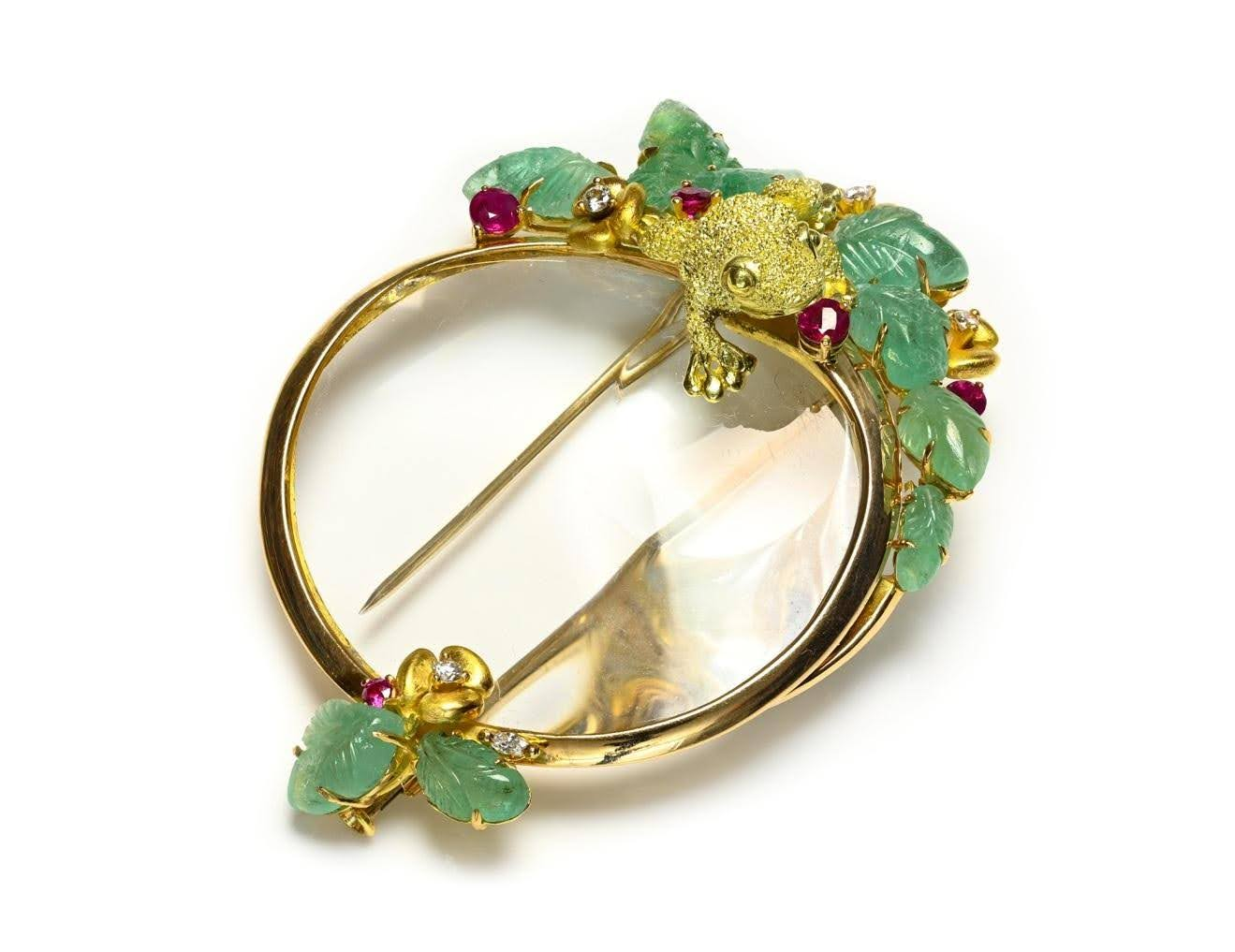
A brooch can sit traditionally on a lapel, but it can also be positioned at the neckline of a dress, attached to a scarf, worn on a coat, placed on a hat, or used to add character to structured tailoring. Depending on the material, construction, and pin mechanism, some can even be used creatively on accessories.
Vintage brooches also offer an enormous range of design.
Flowers, animals, insects, abstract forms, geometric compositions, celestial motifs, ribbons, leaves, birds, and whimsical objects have all appeared in fine and designer jewelry. Because a brooch is not constrained by the finger, wrist, or neckline, designers have historically had more freedom to treat it as a small canvas.
For someone who wants jewelry that feels genuinely individual, this category can be especially rewarding.
The Importance of Looking Beyond the Front
One of the pleasures of examining well-made jewelry is discovering how much information exists on the reverse.
The back of a jewel can reveal hinges, pin mechanisms, clasps, construction methods, workshop marks, serial numbers, metal marks, signatures, and finishing details that are invisible when the piece is worn.
With signed jewelry, these details become especially important.
A famous signature alone should never be the entire reason to understand a jewel as authentic or significant. The signature should make sense alongside the construction, period, materials, workmanship, proportions, and known design language of the maker.
The same principle applies to unsigned jewelry. Exceptional workmanship does not disappear simply because there is no famous name attached to it.
Sometimes an unsigned period jewel can offer extraordinary craftsmanship and rarity without the premium associated with a celebrated maison.
Gemstones Add Another Layer of Individuality
No two natural gemstones are exactly alike.
Color, inclusions, proportions, transparency, cutting style, and origin can give stones individual personalities. Older jewelry can be especially interesting because gemstones and diamonds were often cut according to different aesthetic priorities and technologies than those used today.
Old mine-cut and old European-cut diamonds, for example, can show broader facets, visible culets, higher crowns, and subtle asymmetry. Their appearance is different from the precision associated with many modern brilliant-cut stones, and that difference is part of their character.
Colored gemstones introduce another dimension. Sapphires, emeralds, rubies, turquoise, jade, coral, opals, and other materials can define the entire personality of a jewel.
For significant gemstones, documentation can also become important. A laboratory report may provide information about gemstone identity, treatment, origin, or other characteristics depending on the stone and report.
But documentation does not replace looking at the jewel itself.
The emotional response still begins with color, proportion, craftsmanship, and design.
Why Condition Matters
Rare jewelry has often lived a life before reaching its next owner.
That history does not necessarily diminish it. In many cases, subtle evidence of age is entirely appropriate. What matters is understanding what has happened to the piece.
Buyers should consider whether a jewel has been resized, repaired, polished, converted, restored, or altered. They should examine clasps, hinges, prongs, enamel, stone security, and areas of repeated wear.
Older jewelry may also contain later components or replacement stones. These are not automatically reasons to reject a piece, but they should be understood when they materially affect the design, integrity, or collectibility of the jewel.
A good description should help a buyer understand the object rather than simply persuade them to desire it.
Jewelry Watches: Where Function Meets Design
Jewelry watches occupy an especially interesting position because they combine mechanical function with adornment.
Some designs announce themselves immediately as watches. Others conceal the dial beneath gemstones or decorative goldwork so successfully that they appear first to be bracelets.
This has allowed jewelry houses to approach watch design with remarkable creativity.
Bracelet watches, cocktail watches, secret watches, cuff watches, pendant watches, and highly decorative evening watches can all appeal to someone who thinks of a watch as part of their jewelry wardrobe rather than merely a device for telling time.
When considering an older jewelry watch, buyers should look beyond the case and gemstones. Movement condition, service history where known, bracelet length, dial originality, replacement components, and clasp condition are all relevant.
Yet the best examples succeed aesthetically even before the time is read.
Rare Objects Expand the Idea of Collecting
Jewelry collecting does not always end with jewelry.
Many of the same houses and workshops that produced exceptional jewels also created vanity cases, minaudières, cigarette cases, desk clocks, travel clocks, boxes, compacts, frames, and other objects.
These pieces can combine gold, silver, enamel, hardstones, gemstones, lacquer, engraving, and miniature mechanical components.
They belong to a broader tradition in which luxury craftsmanship entered daily life through beautifully made objects.
This wider collecting world is part of The DSF Collection, where jewelry sits alongside watches and unusual objects selected for design, craftsmanship, rarity, condition, and character.
For a collector, these objects can be particularly appealing because they are less expected. Someone may begin by looking for a ring or bracelet and discover an enamel clock, a miniature case, or a jeweled object they had never considered collecting.
Discovery becomes part of the experience.
Personal Style Is Stronger Than a Trend Cycle
The most compelling reason to wear rare jewelry may have very little to do with investment, age, or even prestige.
It is simply that unusual jewelry helps create a personal visual language.
Fashion trends move quickly. A particular silhouette, metal color, gemstone, or jewelry category can become ubiquitous and then disappear from view just as rapidly.
A distinctive jewel operates differently.
A person may continue wearing the same vintage bracelet, signet ring, unusual brooch, Cartier earrings, or antique diamond ring for decades because the piece has become associated with them rather than with a particular season.
That is where collecting and personal style begin to overlap.
The jewel is no longer simply something purchased because it was fashionable. It becomes part of the wearer's identity.
Buying Rare Jewelry Online Should Still Feel Personal
The internet has made extraordinary jewelry accessible to buyers far beyond the cities in which specialist dealers are located, but rare jewelry still benefits from conversation.
Scale can be difficult to understand from photographs. A buyer may want to know how heavy earrings feel, how a bracelet articulates, whether a ring can be resized, how a brooch mechanism operates, or whether additional photographs of signatures and hallmarks are available.
Important jewelry may also include laboratory reports, original boxes, archival information, or other documentation that a buyer wants to understand before purchasing.
That is why the best online jewelry experience combines detailed digital presentation with access to a knowledgeable person when questions arise.
Technology may introduce the jewel. Expertise and communication help the buyer understand it.
The Pleasure of Finding Something You Were Not Looking For
Perhaps the greatest advantage of a constantly changing collection is unpredictability.
A standardized retail environment is designed so that customers know roughly what they will find. Rare and estate jewelry works differently.
A visitor looking for earrings may encounter an Art Deco brooch. Someone searching for a diamond ring may become fascinated by a carved gemstone. A watch collector may discover an unusual desk clock. A fashion lover may encounter an archival Chanel or Dior piece that suddenly makes sense with the way they dress today.
These discoveries are difficult to manufacture because they depend on objects that are themselves difficult to repeat.
And that may explain why rare jewelry continues to feel relevant even as fashion changes around it.
The most memorable pieces do not simply follow a trend.
They have enough identity to create one.